25 May, 2010

Hepatitis A vaccine


Hepatitis A virus is transmitted by the fecal-oral route (An object contaminated with
the stool of a person with hepatitis A is put into another person's mouth.)

I recommend the persons who travel or live in the countries of Central America,
South America, Mexico, Asia (except for Japan), Africa, and Eastern Europe.

→ more information
➞ http://wwwnc.cdc.gov/travel/yellowbook/2010/chapter-2/hepatitis-a.aspx


Hepatitis A vaccine:  
----------------1) inactivated Hepatitis A virus, which are cultured the cells , 
------------------ derived from the kidney cells of African green monkey. 
------------------ manufactured by Kaketsuken.1-6-1 Okubo, Kumamoto-shi, 
------------------ Kumamoto 860-8568, Japan.
----------------2) more than 16 year old.
----------------3) 
3 times(0, 2~4 weeks and 6-month)0.5ml subcutaneously or 
                             intramuscularly.
                                   

Tetanus vaccine

~~~~~~~
Tetanus
~~~~~~~
Tetanus (lockjaw) is a serious disease that causes painful tightening of the muscles,
usually all over the body. It can lead to "locking" of the jaw so the victim cannot
open his mouth or swallow. Tetanus leads to death in about 1 in 10 cases.
Several vaccines are used to prevent tetanus among children, adolescents, and adults
including DTaP, Tdap, DT, and Td(Centers for Disease Control and Prevention)

Etiology: The bacteria(Clostridium tetani) live in soil and grow in oxygen free
----------- environment. The bacteria enter the body from the injured skin, such as 

-----------car accidents and skin incision site.

Vaccine:  Tetanus toxoid,
------------- 0.5ml, subcutatenously or intramuscularly.

------------- 2 times(3~8 weeks interval)

In childhood, Tetanus vaccine are administered 4 times as DTaP and again at 
11 year old as DT vaccine.  However, after 10 years the antibody titer against
Tetanus is declined.  This is the reason why doctors administer Tetanus vaccine
in the case of deep skin injuries.

11 May, 2010

Tunis, Tunisia(2)


Time stayed : November 21~24, 1987
Place : Tunis(capital), Tunisia
Major languages: Arabic (official); French
Monetary unit: Tunisian dinar


1) from Hotel (November 23, 1987)
2) the center of Tunis:


3) Sidi Bou Said is a town, which is located only 20 km from Tunis.
---------- The walls of houses is white and the window is Tunisian blue
                                      

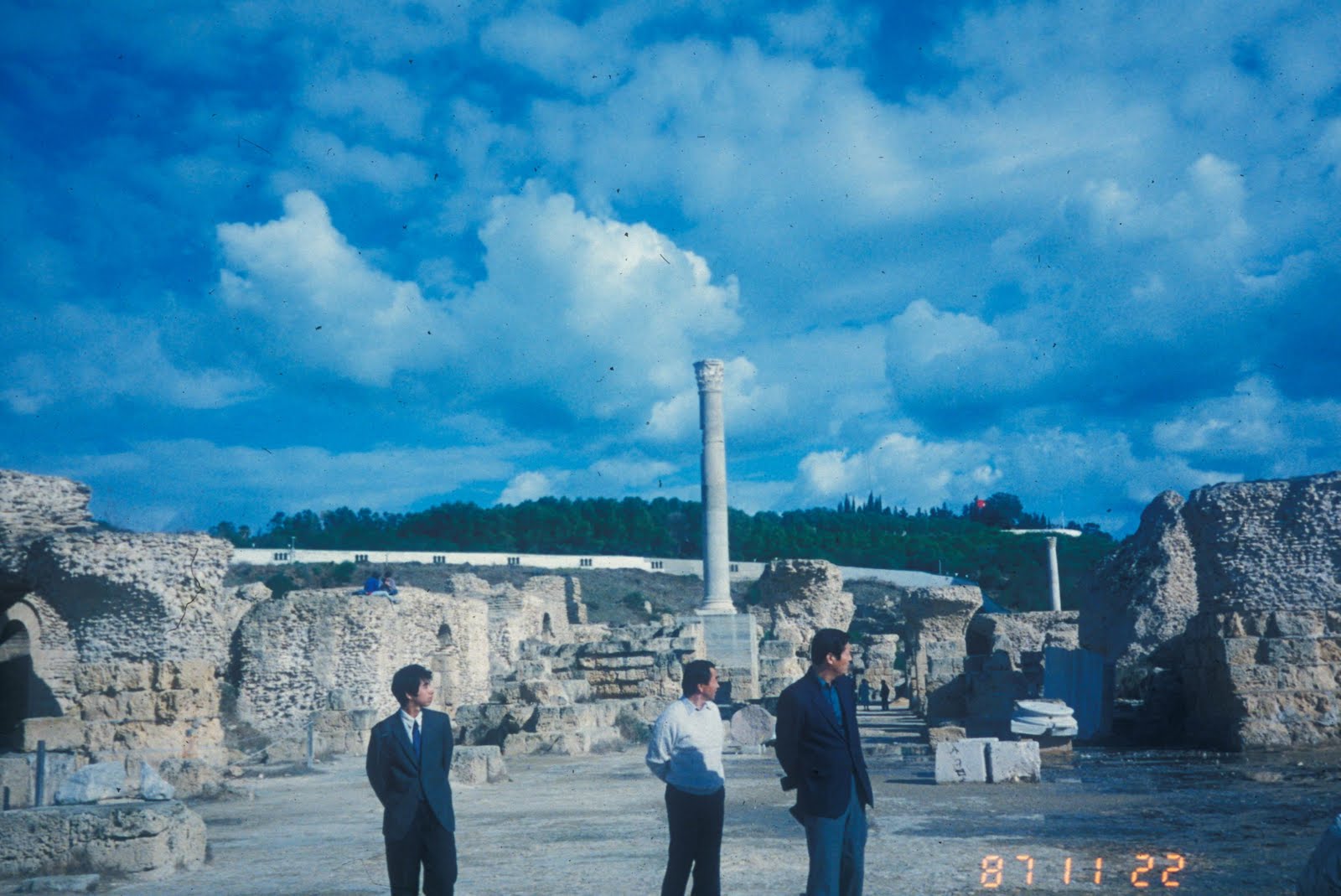
Cartag, Tunisia


Time stayed : November 21~24, 1987
Place : Tunis(capital), Tunisia
Major languages: Arabic (official); French
Monetary unit: Tunisian dinar

The total numbers of Japanese in Tunis: 70(10 children).


Cartage: Carthage is located on the eastern side of Lake Tunis across 
------------from the centre of Tunis.


01 May, 2010

Rabat to Casablanca

The road from Rabat to Casablanca:  good highway.

Rabat, Morocco

Time:November 18〜19
Place:Rabat, Morocco
Language: Arabic (official), Berber, French, Spanish
Monetary unit: Dirham


The Japanese in Rabat: 61 (+8 child). 
2 child was born in Dr. Benjelloun Hassan, Prof. Agrègè de Gynècologie-Obstètrique, 
du C.H.U. de Rabat 11, Rue de Meknès-Rabat. 
The lunch was served in Ambassador's residence.

Mausoleum of Mohammed V:


Hand, Foot, and Mouth disease

April 30th. 3-year-old boy came to my clinic.
--------- Hand-Foot- Mouth disease is small epidemic in a kindergarten.


Usually this disease is epidemic in Summer.  Recent weather in Ube city, 
is unpredictable; one day---- summer, next day---- autumn----- 
hot summer ------ .

1) Hand: small vesicles with no itching and no pain.

2) Foot:

3) Mouth:  sores(+) ------ cause pains---- sorry no photos.

27 April, 2010

Casablanca, Morocco

Time : November 16~18, 20~21, 1987.
Place: Casablanca, The Kingdom of Morocco
Major languages: Arabic (official), Berber, French, Spanish
Major religion : Islam
Monetary unit : Dirham = 100 centimes
Main exports : Minerals, seafood products, citrus fruit


The total numbers of Japanese, who live 3 months more = 50(+5 children).
We done health consultations of attaches, Embassy of Japan and other Japanese.

the center of Casablanca
                                     
from hotel window

Rabies vaccine


Rabies vaccine(Kaketsuken)

1) Transmission: Bitten by rabies-infected dogs.
-------------------The most common wild reservoirs of rabies are raccoons, skunks, 

------------------- bats, foxes,coyotes, cats and cattle.
2) Rabies vaccine: Inactivated Tissue Culture Rabies Vaccine.

------------------ Rabies virus(HEP Flury strain), culture in Chicken embryo cells.
3) Manufacture:    Kaketsuken, Kumamoto 860-8568, Japan
4) Dosage :
----------- 1) pre-exposure: 3 times( 0, 4 weeks later, 6~12 months later)

------------------------------- subcutaneously( not intramuscular).
---------- -2) post-exposure: 6 times.

Any questions: write to Keiji Hagiwara, MD
---------------------------------Kami-Ube Pediatric Clinic,
---------------------------------Ube 755-0097, Japan
---------------------------------keijihagiwara@gmail.com

22 April, 2010

Herpes zoster (Shingles)

1) What is Herpes zoster (Shingles)  ?
small blisters with itching and burning pain
----- a stripe or belt-like pattern along with rib.

2)  Commonly occurs on the torso(65%), but can appear on the face, eyes (20%)
-------or other parts of the body(15%).  

Herpes zoster(the orbit of the eye and frontal head;
 the ophthalmic division of the trigeminal nerve)
 --------------✳ Ramsay Hunt syndrome: if affect the facial nerve to the 
vestibulocochlear nerve, resulting the hearing loss and vertigo.

Herpes zoster(back region)
Herpes zoster(Thigh region)

3)  The causative agent: Varicella zoster virus (=VZV )
Electron-microscopic image(white bar=100nm)

Herpes zoster occurs only in person who suffered from Chickenpox.  
After recovered, the virus live in the spinal nerve ganglia( There are 8 cervical nerves, 
12 thoracic nerves, 5 lumbar nerves and 5 sacral nerves) adjacent to the spinal cord.
When a person have a stress or aging, the VZV is reactivated and go through the
nerve and rise to the skin regions.


4) Age: the majority of sufferers are older persons. Rare in infant.

5) Treatment )   i) Topical ointment: the mixture of 10% Zinc oxide and 2% phenol.
---------------- -ii) Antiviral drugs:  Acyclovir, Valaciclovir
----------------- ☆ The rash and pain usually subside within one month in child, but 
--------------------- some elderly patients develops a painful condition. In such case,
----------------------Please ask doctors.


Any questions:    write to      Keiji Hagiwara, MD
---------------------------------Kami-Ube Pediatric Clinic,
---------------------------------Ube 755-0097, Japan
---------------------------------keijihagiwara@gmail.com

Mumps vaccine


Mumps vaccine:  a live attenuated vaccine.  
Age ::   one year old or older.
Side effect of vaccine:  aseptic meningitis(1/5,000~1/10,000 ??)

➞ MMR vaccine contain Mumps, Measles and Rubella viruses.

21 April, 2010

Mumps

Mumps: The swelling start from the site, under the Earlobe,
where parotid gland is there. Submandlbuiar glands are also
swelling.  At 2~3 year old, it is sometimes difficult to notice.
~~~~~~~~~~~~~~~~~~~~~~~~~~~~
Mumps (Parotitis due to Mumps virus):
~~~~~~~~~~~~~~~~~~~~~~~~~~~~
1) incubation period: 2~3 weeks
2) causative agent: Mumps virus
4) ages: 2~3 year and older.
5) complication:
------ i) After puberty, Orchitis occur, resulting the decrease of testicular Sperm's numbers.
------ ii) Aseptic meningitis: it's frequency may be 1/30~~1/300)
------ iii) Deafness: 1/10,000~20,000.

---- if your child suffered 2 or more times of Parotitis---- it is " recurrent parotitis".
----- Parotitis due to Mumps virus is suffered only one time.

6) prevention:  Mumps vaccine( MMR vaccine contain this vaccine)

Exanthema subitum(Roseola) ?

~~~~~~~~~~~~~
7 month old, boy
~~~~~~~~~~~~~
April 19. at noon, mother noticed fever 39.2℃. No cough, No running nose.

-----  20. at night, fever fell down and eruption appeared face and trunk.
-----  21. came to Clinic. Measles like eruption at trunk( front >back), face.
---------- not in hand and foot.


Comment:  This is not Exanthema subitum(Roseola), since duration of fever 
ーーーーーwas 1.5 days, two short ----- may be a type of Echovirus infection.

Any questions: write to Keiji Hagiwara,
--------------------------- Kami-Ube Pediatric clinic,
--------------------------- keijihagiwara@gmail.com

20 April, 2010

Cholera vaccine


1) Vibrio cholerae (Electron-microscopic image, x 2,000)


2) certificate of Cholera vaccine ( formerly used ):


3) killed whole-cell(Vibrio cholerae 01) vaccine for injection:
----- In 2001, WHO recommended the stop to use of this vaccine. 

------prophylactic usage is not currently recommended for routine use by the 
----- Centers for Disease Control and Prevention.

4) Oral cholera vaccine:
----- Brand name: Dukoral 
----- Munufacture: Crucell, Leiden,The Netherlands ( http://www.crucell.com/ )
------Dukoral® was first licensed in 1992 and is now licensed in over 60 countries.
------ Vaccine components: killed whole-cell Vibrio cholerae O1 and recombinant B subunit
-----------------------------------of cholera toxin. also protective against Vibrio cholerae 139.

Any questions:  write to Keiji Hagiwara,
--------------------------- Kami-Ube Pediatric clinic,
--------------------------- keijihagiwara@gmail.com

18 April, 2010

Yellow fever vaccine


1) Vaccine          : live attenuated vaccine 
2) Trade name   : YF-VAX®
3) Manufacture : Sanofi Pasteur
4) Dosage, administration : reconstitute immediately before use with the sterile diluent provided 
------------------------------------- (Sodium Chloride Injection USP – contains no preservative).
-------------------------------------- a single subcutaneous injection of 0.5 mL.
5) Booster Doses  : Recommend every 10 years. Some studies suggests that yellow fever vaccine 
----------------------------immunity persists for at least 30 to 35 years and probably for life.
6) Indication         :  1) 9 months of age and older, because of the risk of encephalitis. 
-------------      - ----2) older than 65 year, if vaccinated, elderly persons should be carefully 
--------------  --     ---------monitored for adverse events for 10 days post-vaccination.

7) Contraindications:  1) as in the same of other live vaccines.
--------------------------2) infants less than 9 months of age. 
8) The certificate of Yellow fever vaccination: countries of sub-sahara Africa and south 
----America may be required. Must be ask the the destination country’s embassy or consulate.
-------------------     --------Examples: a) Accra, Ghana
--------------------     ---------------------b) Monrovia, Liberia
-------------------     ----------------------c) Konakry, Guinea


~~~~~~~~~~~~~~~~~~~~~~~~~~~~~~~~~~~~~~~~~~~~~~~~~~~~~~~~~~~~~~~~~~
Countries that require proof of yellow fever vaccination for all arriving travelers


Angola, Benin, Bolivia, Burkina Faso, Burundi, Cameroon, Central African Republic,
Congo, Repubic of the Côte d’Ivoire, Democratic Republic of Congo, French Guiana,
Gabon, Ghana, Liberia, Mali, Niger, Rwanda, São Tomé and Príncipe, Sierra Leone,
Togo.

※ Country requirements for yellow fever vaccination are subject to change at any time;
---- therefore, CDC encourages travelers to check with the destination country’s embassy
---- or consulate before departure.


~~~~~~~~~~~~~~~~~~~~~~~~~~~~~~~~~~~~~~~~~~~~~~~~~~~~~~~~~~~~~~~~~~
References → Traveler's Health( Centers for Disease Control and Prevention)


Any questions:    write to      Keiji Hagiwara, MD
---------------------------------Kami-Ube Pediatric Clinic,
---------------------------------Ube 755-0097, Japan
---------------------------------keijihagiwara@gmail.com

17 April, 2010

Donka National Hospital, Conakry, Guinea

Time:  November 16, 1987.
Place: Donka National Hospital, Conakry, Guinea.

1) The car for blood transfusion by the donation from Japan:


2) Donka National Hospital:  poor equipped, not-clean hospital.
                                      
3)  Sun light drying of clothes in the street, Conakry.
                                    
4) A Hotel in Conakry:

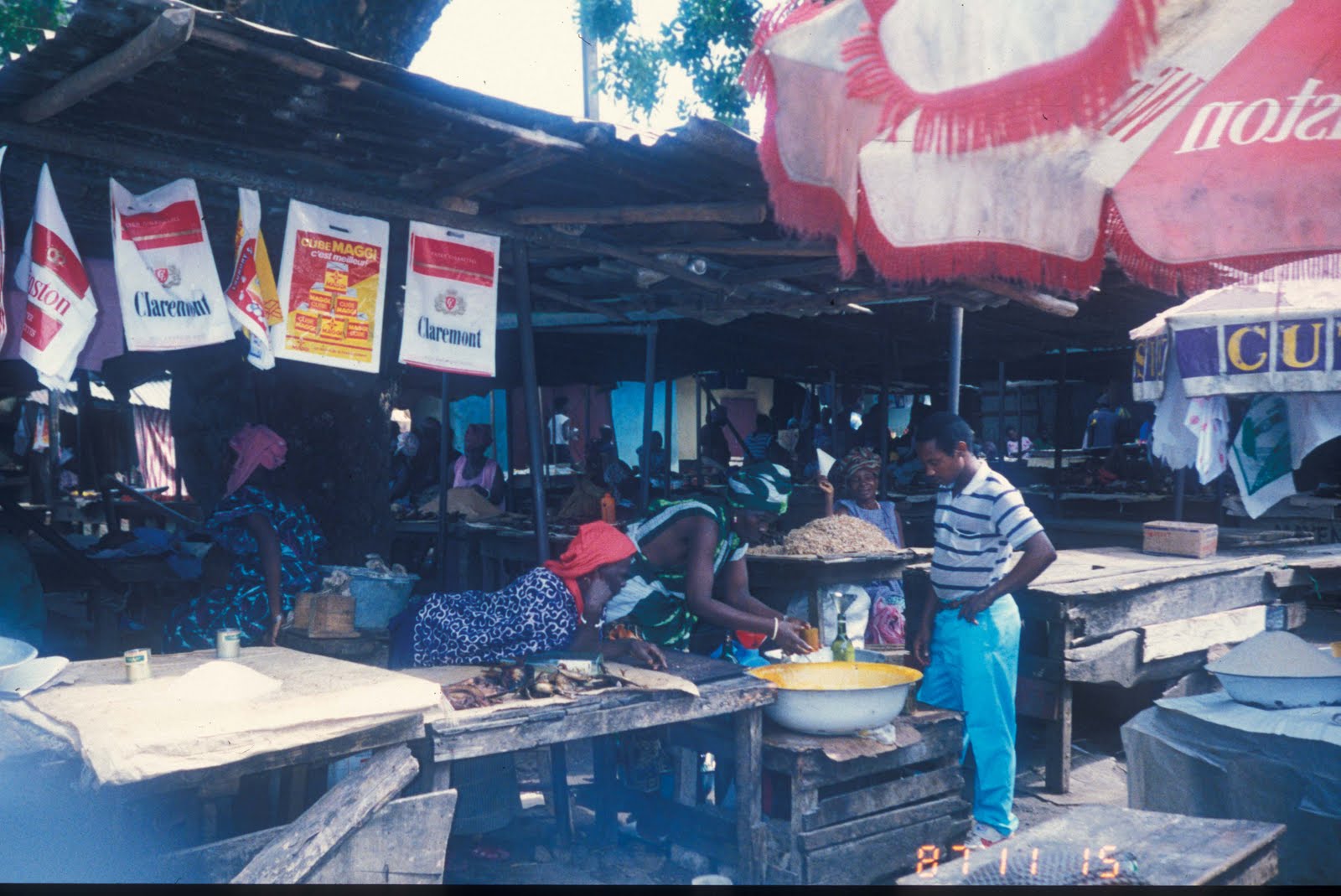
A market at Conakry, Guinea

Stay period : November 14~17, 1987.
Place           : Conakry(capital),The Republic of Guinea
Major languages: French, various tribal languages
Major religions: Islam, Christianity, indigenous beliefs
Monetary unit : 1 Guinean franc
Electricity        : 220V, 50c/s

Photos)  taken at a market in Conakry.  Do not take photo, because the
---------- peoples in Guinea dislike. I took the photos from the behind the
---------- colleagues.